Bey Citadel: A Masterpiece of the Mamluk Era The Bey Citadel, dating back to the Mamluk period, is located on the same site as the ancient Lighthouse of Alexandria. It was built in 882 AH (1477 AD) by Sultan Al-Ashraf Abu Al-Nasr Saif Al-Din Qaitbay on the eastern side of Pharos Island in the eastern...Read More
Griechisch-römisches Museum in Alexandria Die Idee, dieses Museum zu errichten, entstand 1893 in einem zunächst kleinen Gebäude, das nicht genügend Antiquitäten beherbergte. Daher wurde beschlossen, das Alexandria-Museum zu errichten, das heutige Gebäude, das Griechisch-römisches Museum in Alexandria Geschichte und Eröffnung des Museums Von einem deutschen Ingenieur entworfen wurde Drietzsch und der Niederländer Steun. Es wurde...Read More
Das Schloss von Salah al-Din al-Ayubi: Eine beeindruckende Festung Das Schloss von Salah al-den al-Ayobi Es wird Bergburg genannt, das wichtigste archäologische Wahrzeichen Kairosund die bedeutendste im Mittelalter erbaute Militärburg. Es wurde von König Al-Nasser, Saladin Al-Ayyubi, in den Jahren 564 bis 589 n. Chr. (1169 bis 1193 n. Chr.) auf dem Gipfel des Berges...Read More
Die Große Muhammad-Ali-Pascha-Moschee: Ein Symbol der Pracht Zuerst, Die Große Muhammad-Ali-Pascha-Moschee, auch als Alabaster-Moschee bekannt, ist ein bedeutendes Wahrzeichen in Kairo,ebenfalls Sie befindet sich in der nordwestlichen Ecke der Zitadelle von Salah al-Din, zudem Ihre Wände sind mit Alabaster verkleidet, einer der seltensten Marmorarten der Welt. Die beiden hoch aufragenden Minarette erreichen eine Höhe von...Read More
The Sultan Hassan Mosque and Madrasa: A Masterpiece of Islamic Architecture The Sultan Hassan Mosque and Madrasa, a prominent landmark in Cairo, is located at the Citadel Square, directly opposite the Al-Rifai Mosque. This monumental structure, often called the “Pyramid of Islamic Architecture,” is considered one of the most impressive architectural wonders in the world....Read More
The Al-Rifai Mosque in Cairo: A Masterpiece of Architecture and History The Al-Rifai Mosque, named after Imam Ahmed Al-Rifai, is one of the most famous and largest mosques of the 20th century. It is located at Salah al-Din Citadel Square in Cairo, directly opposite the Sultan Hassan Mosque. Construction of the mosque began in 1869...Read More
Isadora Cemetery This is one of the tombs shaped like houses, known as burial houses, built in the style of Greek houses. At that time, this house represented a new style of tomb architecture previously unknown in Egypt. The house is made of baked mud bricks, has a dark color, and is painted white both...Read More
Fayoum Fayoum is a large natural oasis covering an area of about 17,000 square kilometers. It once contained a large lake that flooded most of its area. What remains today is Lake Qarun. History and Significance In ancient times, it was called the “Land of the Lake” and was known as “Ba-Yum.” It is considered...Read More
Temple of Abu Simbel Among Egypt’s most famous archaeological sites are the two temples of Abu Simbel, which were included in the UNESCO World Heritage list in 1979, alongside Abu Simbel to Philae. They lie about 240 kilometers southwest of Aswan on the west bank of the Nile, between the first and second cataracts. The...Read More
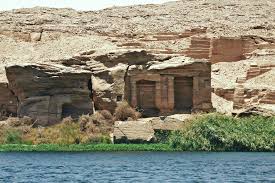
Gabal el-Silsilah (Al-Selsela Mountain) Al-Selsela Mountain is one of the most important archaeological sites in Aswan, located on both the eastern and western banks of the Nile between Edfu and Kom Ombo, about 60 kilometers from the magnificent Temple of Edfu. Its significance comes from its special and unique topographical location at the narrowest part...Read More